Choosing the right model
You're shipping an app with Claude. Which model do you pick? If you default to the smartest one, your API bill will surprise you. Pick the cheapest one, and the output might not hold up. Each model has different trade-offs, and picking the right one affects both quality and cost.
한국어 대본
- 00:00Claude로 앱을 출시합니다. 그렇다면 어떤 모델을 선택해야 합니까? 만약 그냥 가장
- 00:07똑똑한 모델을 기본으로 선택하면, API 요금이 예상을 벗어날 것입니다. 가장 저렴한 모델을 선택하면 출력이 버티지 못할 수도
- 00:13있습니다. 각 모델에는 서로 다른 트레이드오프가 있습니다. 올바른 모델을 선택하는 것은 품질과 비용 모두에 영향을 미칩니다.
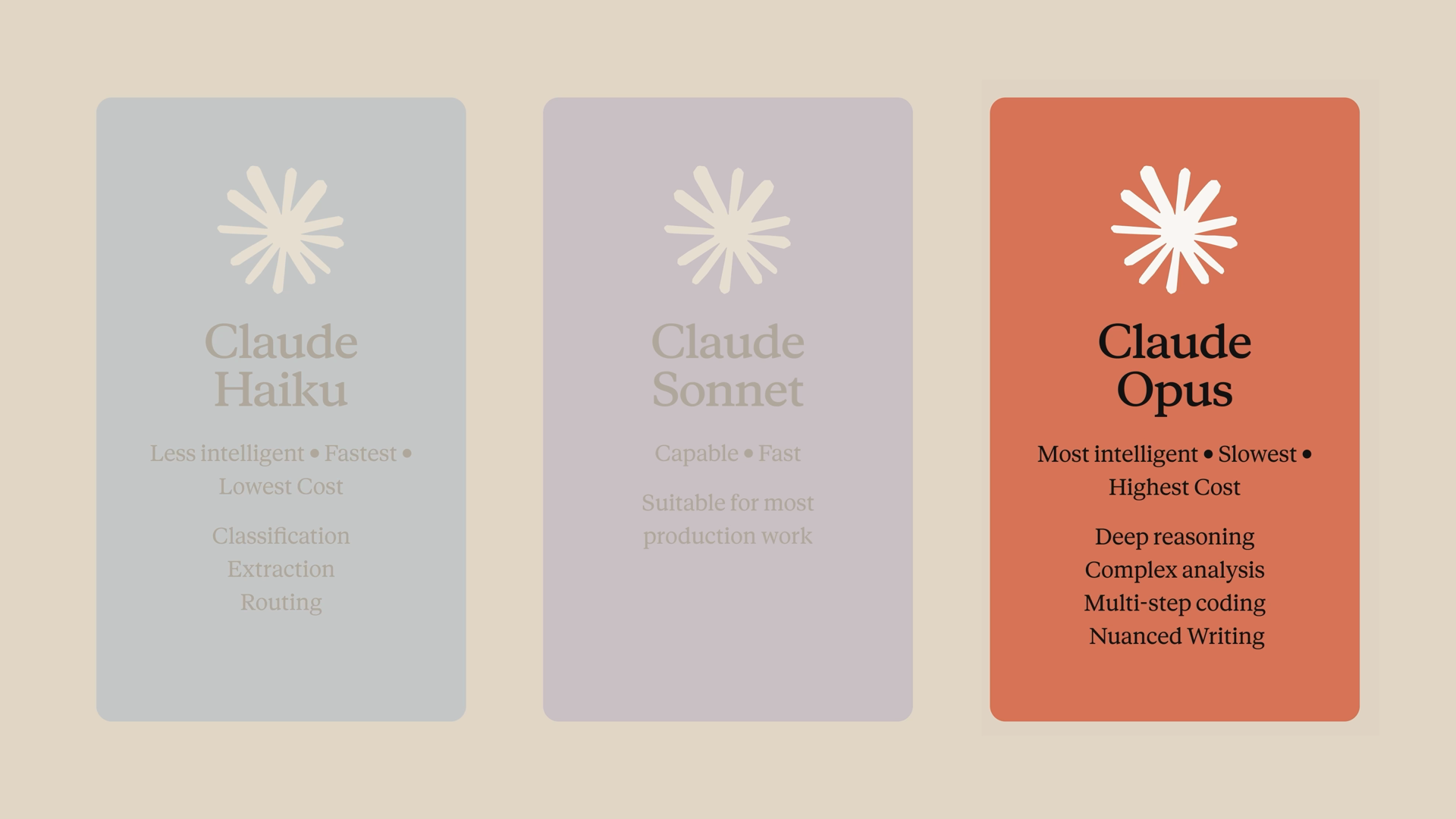
- 00:21현재 Anthropic은 세 가지 모델 등급을 제공합니다. Claude Opus는 가장 지능적이지만,
- 00:26가장 느리고 비용도 가장 높습니다. 심층 추론, 복잡한 분석,
- 00:32여러 단계로 이어지는 코딩, 섬세한 글쓰기에 사용하세요. Claude Haiku는 가장 빠르고 저렴하지만,
- 00:37지능은 낮습니다. 분류,
- 00:42추출, 라우팅과 같은 대량의 단순 작업에 사용하세요. 그리고 그 사이에 Claude Sonnet이 있습니다.
- 00:47대부분의 프로덕션 작업에 충분히 빠르고 유능하며, 비용은 중간 등급입니다.
- 00:51하지만 프로덕션 코드를 작성하기 전에 간단한 평가부터 설정해 보겠습니다.
- 00:58그것은 각 모델에 대해 실행하고, 활용 사례에서 좋은
- 01:03출력이 무엇인지에 따라 점수를 매기는 예제 입력 세트입니다. 실제 작업 부하에서 가져온 대표적인 예 20~30개면
- 01:08시작하기에 충분합니다. 그럼 먼저 Haiku로 실행해 보겠습니다.
- 01:14품질이 유지된다면 끝입니다. 많은 비용을 절약한 것입니다.
- 01:18그렇지 않다면 Sonnet으로 업그레이드할 때가 된 것일 수도 있습니다.
- 01:23작업이 필요로 할 때만 Opus를 사용하세요.
- 01:27하지만 등급 간 차이를 말로만 듣지 말고 직접 확인해 보겠습니다.
- 01:31그래서 동일한 프롬프트를 세 모델 모두에 보내고 지연 시간과 토큰 수를 확인하겠습니다.
- 01:35여기서 두 가지가 일어납니다.
- 01:37루프는 각 요청에서 모델 필드를 교체합니다.
- 01:40동일한 프롬프트, 동일한 최대 토큰 수, 모델만 변경됩니다.
- 01:43그리고 response.usage는 API에서 입력 및 출력 토큰을 곧바로 반환합니다.
- 01:49이것이 비용 계산의 기준입니다. 그럼 실행해 보겠습니다. 세 모델과 세 세트의
- 01:54숫자를 보게 될 것입니다. Opus가 먼저 반환되고 가장 오래 걸리며 가장 정돈된 결과물을 제공하지만,
- 01:59두 문장짜리 정의에는 그런 정돈된 느낌이 낭비입니다. Sonnet이 그다음으로 오고, 문장이 더 간결해집니다.
- 02:05조금 더 걸립니다. 그리고 나서 Haiku가 마지막으로 나오는데, 종종 1초도 안 되어 매우 유능한 두 문장의
- 02:11답변을 제공합니다. 솔직히 이런 유형의 시나리오에 완벽합니다. 그리고 그것이 핵심입니다. 올바른
- 02:15모델은 실제로 결과물을 내보낼 수 있는 가장 저렴한 모델입니다. 정의를 내리는 데는 Haiku로 충분합니다.
- 02:21규제 대응 문서를 작성할 때도 같은 비교를 수행하게 되고, 아마도
- 02:26Opus를 선택하게 될 것입니다. 평가는 매번 동일한 형태입니다. 그래서 실제 앱에서는
- 02:32같은 엔드포인트 안에서 서로 다른 종류의 작업을 서로 다른 모델로 라우팅하게 됩니다. 이 운영 대시보드에서는
- 02:36문서 처리 경로가 들어오는 모든 파일을 Haiku로 분류하지만, 클라이언트
- 02:42업데이트는 Sonnet으로 작성하고, RFP 응답에만 Opus를 사용합니다. 하나의 큐, 세 가지 모델, 작업별로 선택되는
- 02:48작업. 작업에 맞는 올바른 모델을 선택할 때는 어려운 문제에는 Opus를, Sonnet을
- 02:54일상적인 작업에는, 그리고 Haiku를 대량 작업에는 선택하세요. Haiku부터 시작해 평가를 실행하면, 결국
- 03:00여전히 작업을 수행할 수 있는 가장 저렴한 모델에 도달하게 됩니다.
The model tiers
Anthropic currently offers four model tiers, and you choose between them with the model parameter in your API call.
- Claude Fable is our most capable model yet — a new tier that sits above Opus, built for your toughest challenges. It comes at a significantly higher cost than Opus, so reserve it for work where that extra capability is worth paying for. The current Fable model is Claude Fable 5 (
claude-fable-5). - Claude Opus is the most capable of the three core model families, but also the slowest and highest cost of the three. Use it for deep reasoning, complex analysis, multi-step coding, and nuanced writing. The current Opus model is Claude Opus 5 (
claude-opus-5). - Claude Haiku is the fastest and lowest cost, optimized for speed and cost efficiency rather than maximum intelligence. Use it for high-volume, low-complexity work like classification, extraction, and routing. The current Haiku model is Claude Haiku 4.5 (
claude-haiku-4-5). - Claude Sonnet sits in the sweet spot: a balanced combination of intelligence, speed, and cost that works well for most production work. The current Sonnet model is Claude Sonnet 5 (
claude-sonnet-5).
Start with a simple evaluation
Before you write production code, set up a simple evaluation: a set of example inputs that you run through each model and score against what good output means for your use case. You don't need anything fancy — 20 or 30 representative examples from your actual workload is enough to start.
Then work your way up the tiers:
- Run your examples through Haiku first. If the quality holds, you're done — and you just saved a lot of money.
- If it doesn't, step up to Sonnet.
- Only reach for Opus when the task needs it.
Comparing the tiers side by side
Let's see the difference between the tiers, not just talk about it. We'll send the same prompt through all three models and watch the latency and token counts:
Two things are going on here:
- The loop swaps the
modelfield on each request. Same prompt, same max tokens — only the model changes. response.usagegives you the input and output tokens straight back from the API, which is what your bill is calculated on.
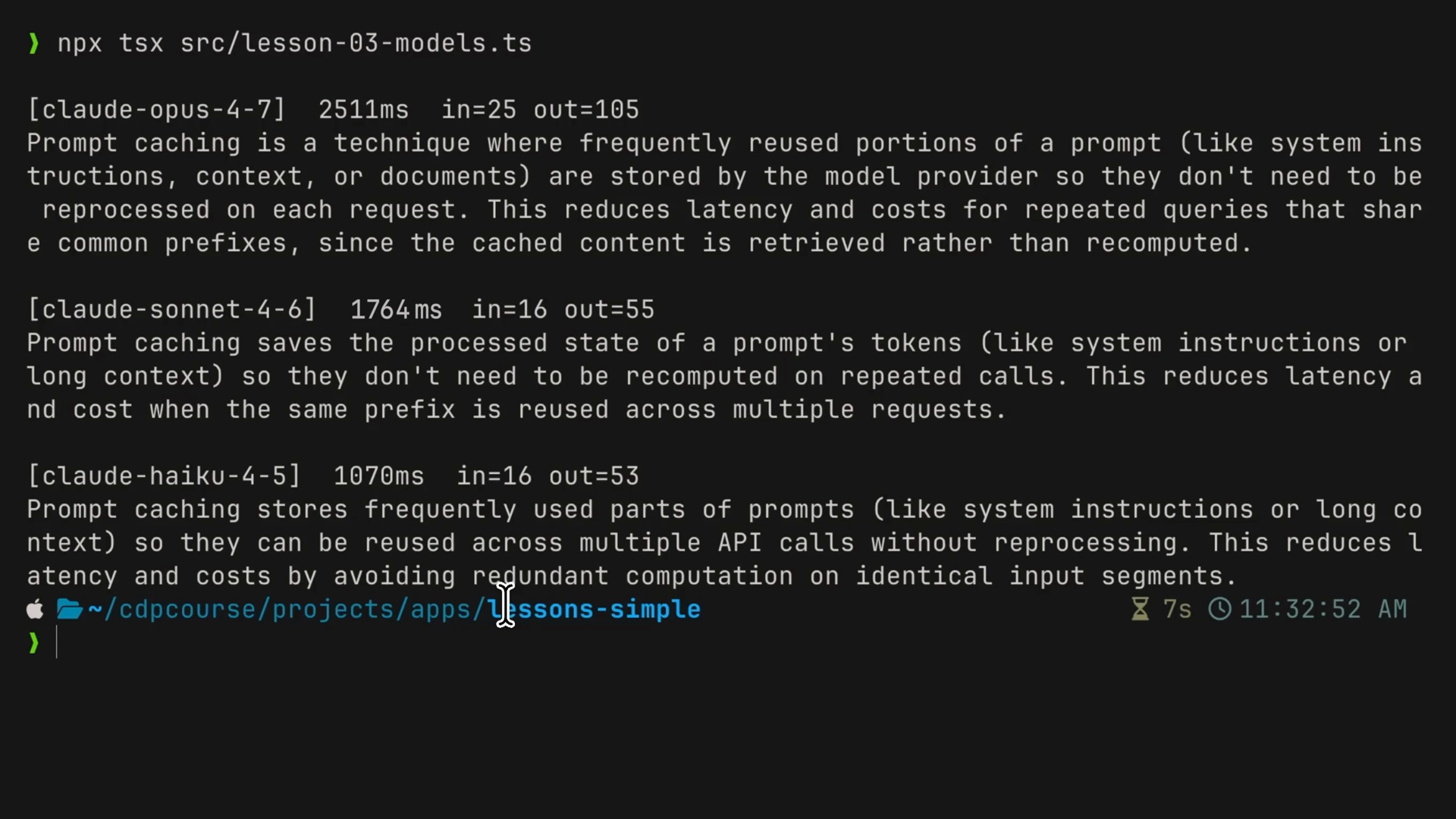
Run it and you'll see three models and three sets of numbers. Opus takes the longest and reads the most polished — but for a two-sentence definition, that polish is wasted. Sonnet tightens the writing up a little. And Haiku comes back, often in under a second, with a very competent two-sentence answer. It's honestly perfect for this kind of scenario.
And that's the whole point: the right model is the cheapest one whose output you'd actually ship. For a definition, Haiku is plenty. For drafting a regulatory response, you'd run the same comparison and probably end up on Opus. The eval is the same shape every single time.
Routing different work to different models
In a real app, you'd route different kinds of work to different models inside the same endpoint. Take an operations dashboard with a document processing route:
- Every incoming file gets classified with Haiku.
- Client updates get drafted with Sonnet.
- Only RFP responses reach for Opus.
One queue, three models, picked per task.
Recap
- Anthropic offers four model tiers: Fable for the highest available capability, Opus for hard problems, Sonnet for daily work, and Haiku for volume.
- Set up a simple evaluation — 20 or 30 representative examples from your real workload — before writing production code.
- Run the eval from Haiku upward and stop at the cheapest model whose output you'd actually ship.
response.usagereports input and output tokens, which is what your bill is based on.- In production, route different tasks to different models inside the same endpoint instead of picking one model for everything.